Seeing is not believing.
These days, you have to tilt your head, squint your eyes a little and ask: is that real or is that AI?
As an elder millennial, I admit, I was overly confident. I thought I could tell the difference. But after those adorable AI generated bunnies jumping on a backyard trampoline got me, I’m not sure I can trust what I see anymore.
In my work as a behavioral scientist, I see it every day. Humans, interacting with one another and attempting to discern: Can I trust you?
Lately, I’ve been noticing that the go-to answer is a resounding: No way, Jose.
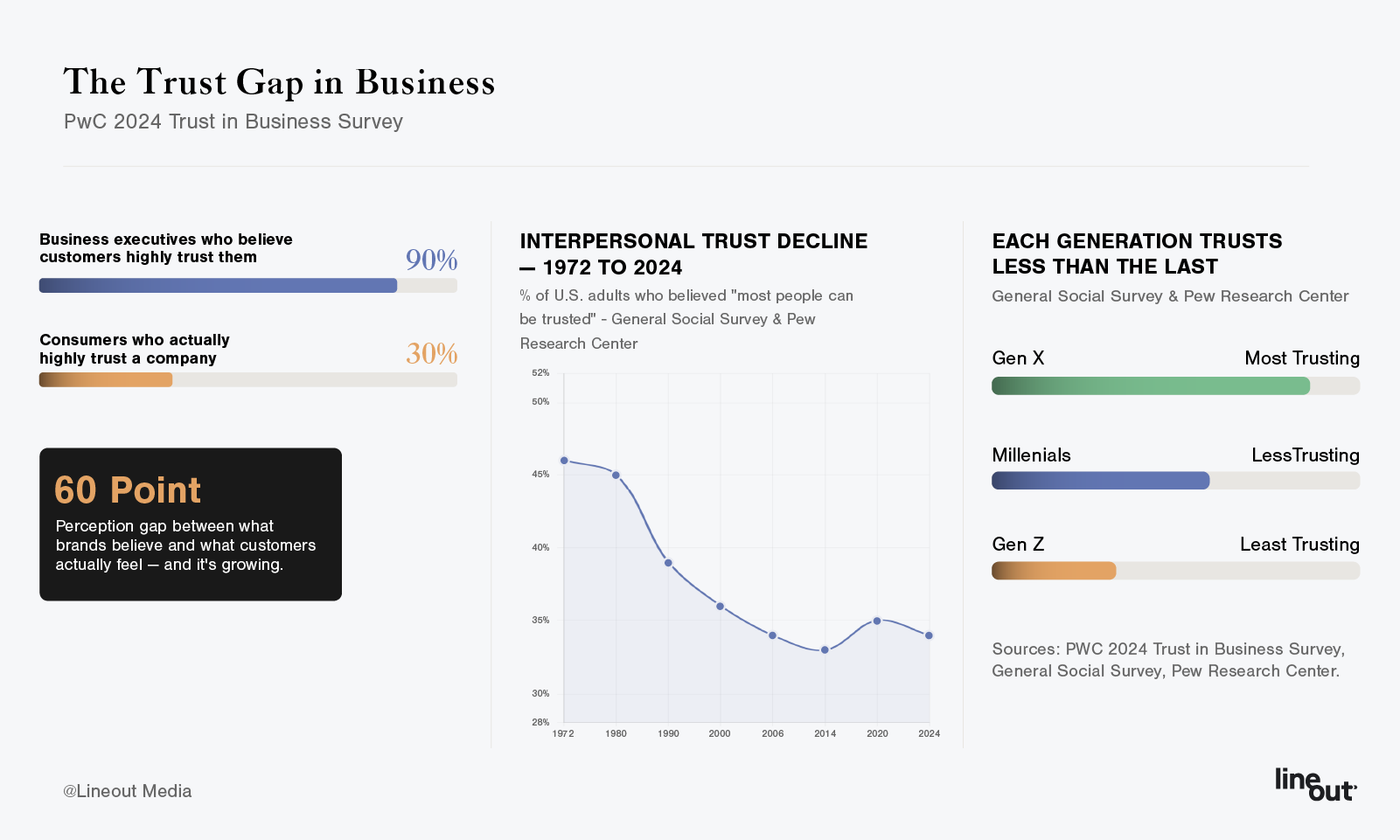
And this perception of mistrust isn't just showing up interpersonally, it's been growing and extending into consumer confidence and relationship banking. Because while 90% of business executives believe their customers highly trust them, turns out only 30% actually do.
That’s a 60-point perception gap, according to PwC's 2024 Trust in Business Survey. Which coincidentally aligns with the General Social Survey and Pew Research Center, where the percentage of U.S. adults who believed "most people can be trusted" declined from 46% in 1972 to just 34% in 2024.
While there are differences across race, gender and income levels, one trend emerges: each generation is less trusting than the previous ones. The Gen Z-ers are less trusting than the Millennials who are less trusting than the Gen X-ers.
We’re going through a collective trust recession.
As much as I'd love to blame it on the AI bunnies, that's just the newest flavor of the week, another example pushing us further along the trust decline that began in the 1970s. But they do point to a deeper and more consistent pattern: uncertainty, suspicion, skepticism, and transactional dynamics that leave consumers feeling exploited and targeted rather than understood.
And while we might think that relationship banking is insulated, due to its non-transcational stance, we can’t ignore the ocean of mistrust our potential and current customers are swimming in.
We have to understand why the “friendly, neighborhood, community bank you can trust” might be met with hesitation in this current climate. And what banks can do to offset the current trend.
“The banks that continue to ignore the growing trust gap and focus on profit generation over consumer attunement will inevitably struggle to sustain long-term growth. It will cost them more to earn the click, the deposit and the referral”
But what is trust, anyway?
Trust is abstract. A big word that we know is important but have a hard time grasping and defining. In the relationship science world, trust is the foundational belief that someone is reliable and consistent. The underlying confidence that they will show up and follow through on their word. Because when the metaphorical shit hits the fan, we want to know we can count on them to help with cleanup.
In the relationship banking world, trust raises a similar question: can customers rely on you to deliver what you promised?
Can they trust that you’ll have their best interest at heart when offering a product; whether it’s a loan, line of credit, or managing cash flows during cyclical business variations. Can they trust that they won’t be a transaction, a number on the sales quota that must be met according to the powers that be?
These questions are being asked across the entire customer journey. From the moment they decide whether or not to give your bank the time of day, to walking into the branch, and ultimately, the holy grail of it all: becoming a long-term, loyal client.
Trust is and has always been a must have. It’s the foundation that determines if any of a bank's marketing efforts land or flop.
The banks that continue to ignore the growing trust gap and focus on profit generation over consumer attunement will inevitably struggle to sustain long-term growth. It will cost them more to earn the click, the deposit and the referral.
::cue the suspenseful soap opera music::
But I think there’s hope. Because as disappointing as the data sounds, it also offers an opportunity for banks to not just tell customers they’re relationship centered but to show them.
To get there, we don't need another marketing acronym, dashboard, or tactic. We'll need to go in a different direction and follow a framework that illuminates how trust is built, damaged, and repaired. The same relationship frameworks that can be used to repair after trust has broken down.
Relational Marketing
There’s no one more famous in the relationship field than gurus, Drs. John and Julie Gottman. Their research mirrors what I notice in my work as a behavioral scientist: trust doesn't automatically appear the moment you meet someone. It's earned through small, daily interactions that accumulate in what researcher Brené Brown calls the trust marble jar.
The marble jar exists in every relationship. It starts empty and fills up one marble at a time.
Our brain remembers who deposited a marble by being supportive when you lost your job. Just as it remembers who reached in and took out handfuls by sharing a deeply personal secret in the group chat.
These marbles are what guide us toward relational marketing. Because the more marbles we add, the more secure, trusting, or even loyal a customer will be.
And collecting trust marbles will always be important for the success of relationship banking.
Building Your Marketing Trust Jar
1. Go Slow: Don’t Get In the Car With Strangers
A "marble jar" friend is someone who has consistently earned trust over an extended period of time. They're reliable. Someone you can share the vulnerable, personal stuff with.
We are strangers to our new customers, and yet we’re asking them to share their most personal information with us, without having deposited a single marble into the jar.
Earning their attachment to our bank means starting off by taking an intentional approach. It means considering that person’s needs from the very first ad to the bottom of the funnel in our retargeting campaigns.
Trust Try: Before your next campaign, map your potential customer's first three touchpoints. Ask yourself: am I asking for too much, too soon? If the first interaction is already pushing for marriage (a sale), slow down. Start with something smaller, something that piques their interest, a resource, a reason to come back. Earn your marble.
2. Curiosity: Tell me what you really really want
Attunement is the process of taking genuine interest in another person’s world; their feelings, their needs, even the things they're not saying out loud. But it doesn't mean we take that information and make assumptions. Instead, we check in and ask questions.
For banks, this is the case for genuine curiosity about your customer. The worries that keep them up at 3am, and what gets them out of bed in the morning.
Trust Try: A relational marketer asks for feedback. Creating easy opportunities to tap into your customer's thought loops is always a win: in-person conversations with relationship managers (RMs), customer service patterns, social media comments, inbox questions, or surveys are filled with valuable information. Because nothing says attunement like: I want to understand you better. Our customers are often more open to sharing than we think. We're just not always interested enough to ask.
3. Reciprocity: Nobody likes a one-sided relationship
Healthy relationships have a particular dynamic: an equal-ish exchange of giving and receiving. Nobody's keeping score because there's a natural back and forth. The relationship nourishes rather than depletes.
Customers are tracking this pattern too. When every communication is a pitch, an ask, with very little in return, they register it. Maybe not consciously, but a marble comes out of the jar.
Trust Try: Reciprocity can be as simple as a bank creating a loyalty program. By rewarding customer referrals with exclusive perks, banks are engaging in a mutually beneficial exchange. A two-directional relationship that honors and respects continued presence. A thank you for being here, for returning, and for your marble.
4. Showing Up: The proof is in the reliability pudding
Successful relationships are not perfect, but they are present. There's follow through, an underlying belief that you can count on them in the good, the bad, and everything in between.
Customers are looking for that same kind of consistency and reliability. It's all too common that we see banks that over-promise and under-deliver. You did not show up in the way you said you would. A marketing catfish. Ick. Never again.
Trust Try: Audit your customer's journey from the first touchpoint to the last. Does what you're promising at the top — in the ad, the subject line, the social post — actually match what's waiting for them when they arrive at the bank branch or website? If there's a gap between what you said and what you’re delivering, you dropped the marble. Go pick it up before your customer finds it first.
5. Repair: This is what an apology looks like
Conflict, ruptures, mistakes; they're part of every healthy relationship. Minimizing, deflecting, or failing to genuinely acknowledge what went wrong only makes it worse. What builds trust is a real apology and a visible course correction.
The bank that says "we got this wrong, here's what we're doing about it" is doing something genuinely rare. And in a trust deficit culture, that's exactly where opportunity lives.
Trust Try: Create a clear and easy path for customers to get help when they've had a sour experience: a charge dispute, disappointing service with an RM, or a lack of follow up after an account opening.
Build a feedback loop that closes the gap between what's being sold and what's actually being delivered. A repair flow framework for both the customer service and marketing teams. While an RM is the direct point of contact, sharing that information up the chain is how marketing stops making the promises that keep breaking trust.
A bank that makes repair easy earns a handful of marbles. In fact, we can earn more trust in how we handle a mistake than we ever could have without it. Accountability isn't just a way to mitigate damage. It's an opportunity to show reliability, which is what ultimately leads to customer loyalty.

The Therapist's Prescription
Chances are your customers are right there with me, throwing trust into the wind. Skeptical. Guarded. After all, we are all taking in deep breaths of collective mistrust.
Which means the relationship banks looking to earn and rebuild trust will have to look beyond the traditional playbook. It's going to take more than tactical fixes. Because the trust recession isn't just a marketing problem, it's a relational one. And that requires a paradigm shift into curiosity, reciprocity, a whole lot of consistently showing up and repairing after mistakes.
The good news about relationship problems is that they can be worked on, with the right behavioral insights.
And this behavioral scientist is telling you: you don't need a rebrand or a new promotional rate. You need a trust marble jar and the patience to fill it. One small, consistent, genuinely human interaction at a time.