Lazy. Entitled. Disrespectful. Self-obsessed. Rude.
No, I'm not talking about Gen Z.
That's what the older generations used to say about us. Remember? And just like those who came before us, we've inherited the generational resentment. These days, all our fears about the world going to hell in a handbasket are directed at the new youths: Gen Z.
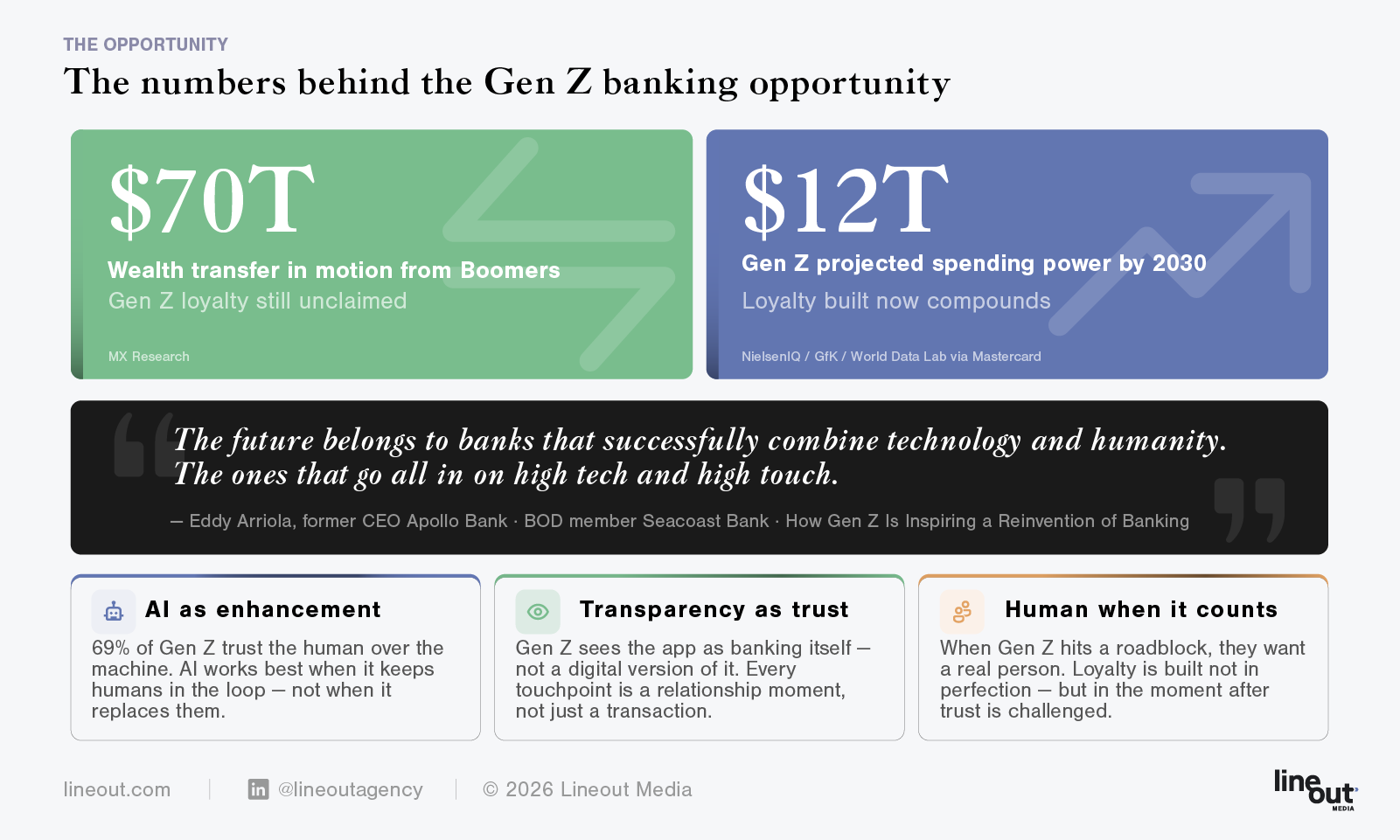
But it just so happens that this good for nothing generation is right in the middle of a $70 trillion wealth transfer. And I don't know about you, but that number should motivate us to be less judgmental and more curious about their behaviors. Because every generation seeks a banking system that caters to their foundational unmet needs.
Baby Boomers grew up in the shadow of scarcity so they wanted stability and reputation. A bank with history, guarantees, and the kind of track record that said: we'll be here tomorrow. Millennials watched institutions collapse and fail them, so they wanted self-reliance. Digital banking gave them the autonomy to manage their own money, on their terms, without needing to depend on anyone. Gen Z is demanding something they've been missing all along: human-to-human connection. Their loyalty is up for grabs, and figuring out how to capture some of that starts with curiosity.
The Error in Our Judgment
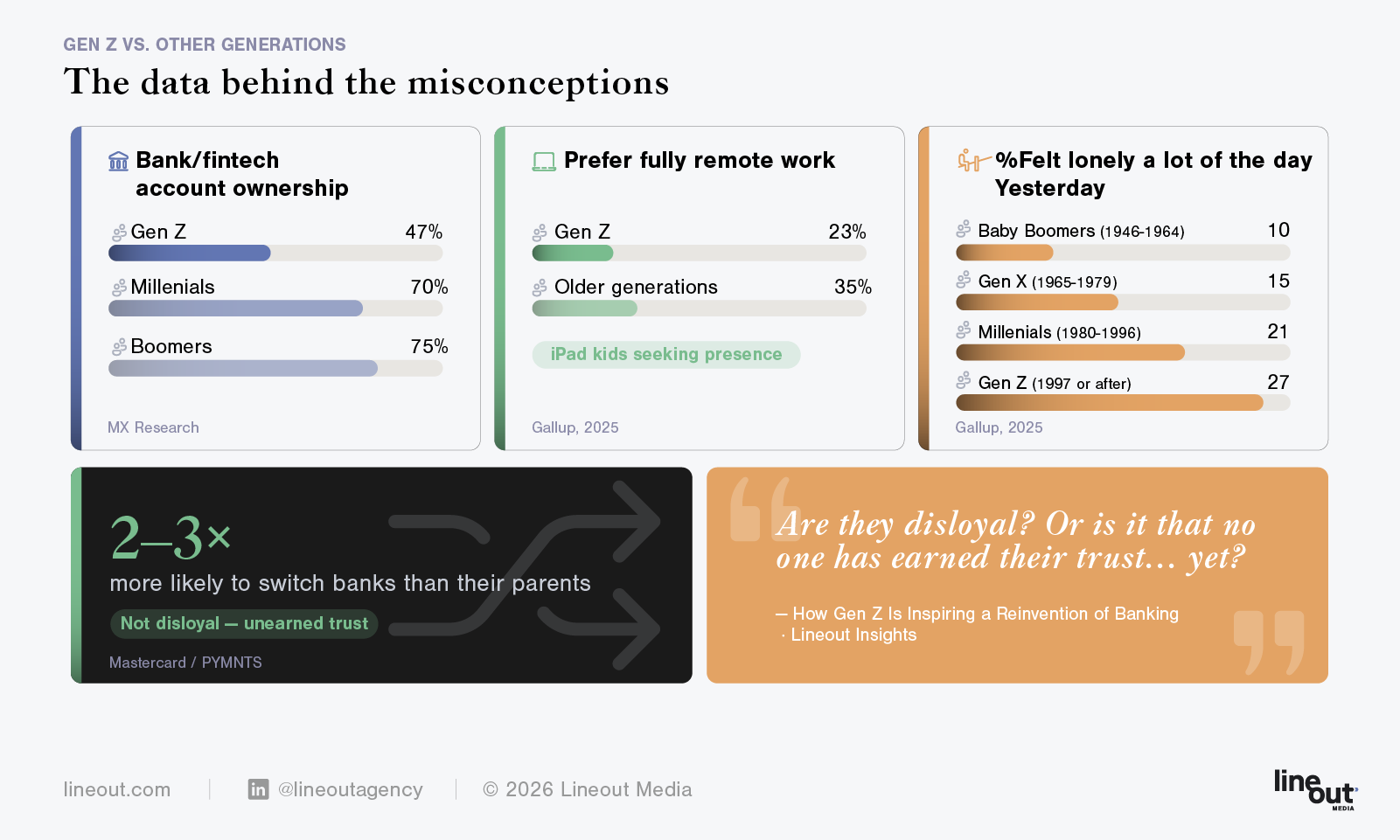
Why is it that only 47% of them have an account with a traditional bank, credit union, or fintech? Or why does Gen Z switch banks two to three times more often than their parents?
Just as the generations before us, we’d be wrong to blame it on personality. Because science tells us the answer is in our brain’s tendency to attribute others' behavior to character, not circumstances.
It’s why when we see that Gen Z is struggling financially (they are), we attribute it to their personality. We say they're lazy, undisciplined. And why when we ourselves struggled at the same age (we did), we blamed it on the economy, the financial crisis, not our personal work ethic.
That attribution error? It’s costing us.
It’s preventing us from seeing how our future customers' banking mistrust and unmet financial needs aren't rooted in personality, but rather sociocultural context.
And that reframe reveals a surprising opportunity: how a generation that has grown up in the age of increasing technological dependence and social isolation might just be the most receptive generation for relationship banking.
The Gen Z Reframe: Broken Down By the Numbers & Behavioral Science
We’ve all got our misconceptions about this generation, but the data tells us a different story.
Are they antisocial or...? Coming of age during the social media explosion, you'd think Gen Z would be more social and connected. But Gen Z is almost 2x as likely as Gen X, and nearly 3x as likely as Baby Boomers, to say they experienced loneliness a lot of the day yesterday. The gap created by the lack of basic human connection means Gen Z isn't antisocial — they're craving connection but have never been given a safe enough place to trust it.
Are these iPad kids always on a screen or…? Ok, this one is actually accurate. But the screen time doesn't point where we think it does. Only 23% of remote-capable Gen Z employees prefer fully remote work, compared with 35% among each older generation. When digital overload is your baseline, you start craving what you don't have. The so-called iPad kids are primed to seek presence. They're looking for ways to exit the matrix.
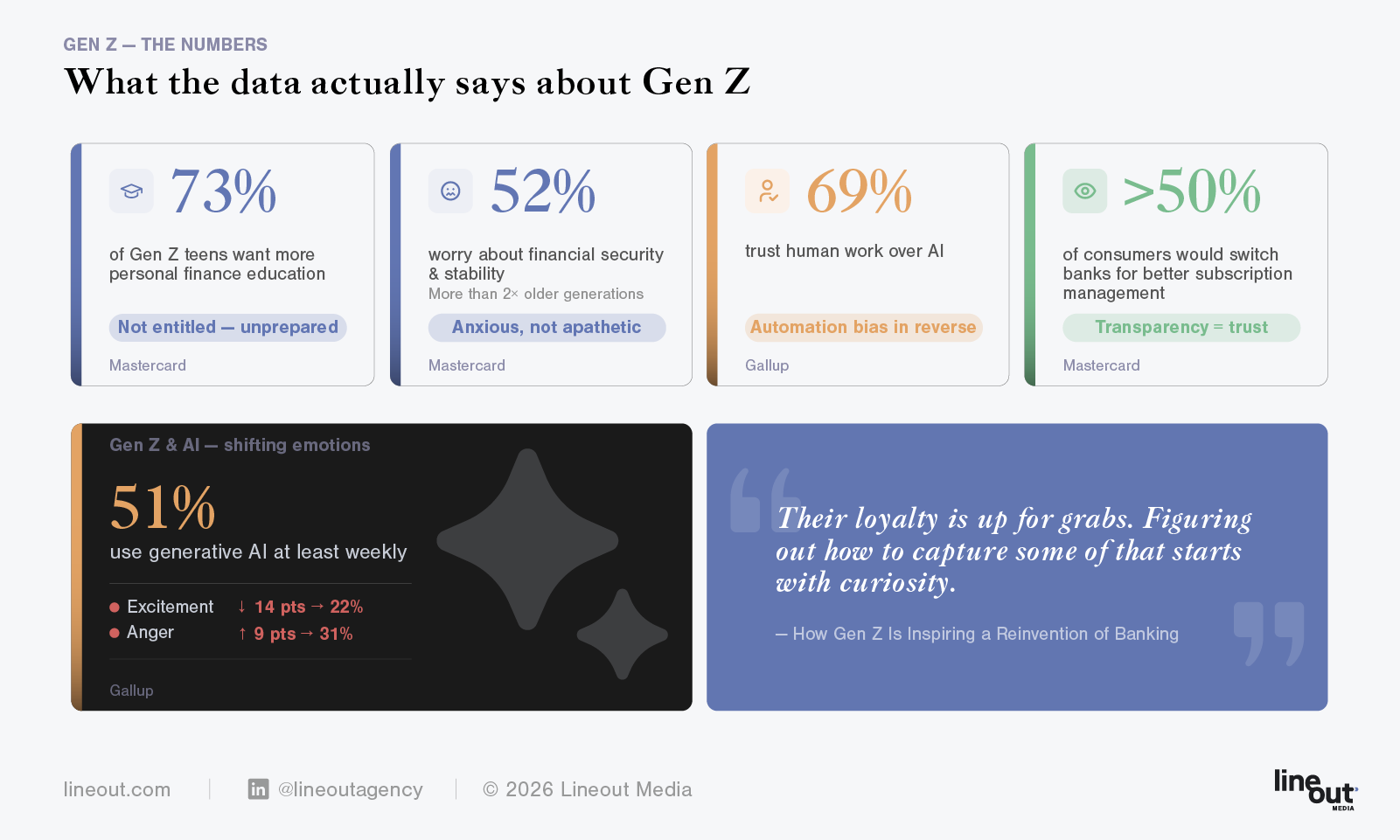
Do they want everything handed to them or…? 73% of Gen Z teens are seeking more personal finance education, and 52% worry about financial security and stability — more than double older generations. Doesn't sound like entitlement. Sounds like a generation that knows no one is coming to save them and is trying to figure it out for themselves.
You see the pattern, right? An amalgam of unmet needs centered around a lack of connection, presence and education. So it's no wonder that when institutions fail them, unconvinced that anyone is on their side, they leave. Are they disloyal? Or is it that no one has earned their trust…yet?
That ‘yet’ is where the opportunity lies. And relationship banking is especially suited to capitalize on it.
But What Even Is Relationship Banking?
If you ask ten bankers what relationship banking is, you'll get ten different answers. But they do agree on the basics:
People vs. product: who it's centered on
Life transitions vs. single transactions: the time horizon
Foundational trust vs. features: what it's built on
According to Eddy Arriola, former founder and CEO of Apollo Bank and current BOD member of Seacoast Bank, we should be asking 'What's best for this customer?' instead of 'What product can I sell them?'
For Gen Z, that distinction matters more than ever. Arriola shares that their financial lives are centered around digital platforms: Venmo, PayPal, Zelle, Apple Pay, Cash App. Which means their smartphones have become the bank branch, the wallet, and the payment network all in one. The bank itself has faded into the background. It’s less visible, less relevant, and ultimately easier to leave.
So as the world of AI continues to permeate every corner of our lives, this generation is wary of going all in. AI automation is accepted as an enhancement but rejected when it replaces humans.
And yet, what hasn't changed—across any generation—is the need for a financial institution they can trust. Customers want security, convenience, and the confidence that someone will be there when they need it most.
Because while products can be copied, rates will change, and technology will always be in flux, trust and relationships are the intangibles that can't be replicated.
For Gen Z, that trust is built in three specific ways.
Human-to-Human Banking: What It Actually Looks Like
1. AI as enhancement, not replacement
Automation bias is the brain's tendency to over-rely on automated systems and algorithmic advice, often believing the machine-generated answers over one's own judgment. But something new is happening in the Gen Z brain: an automation bias in reverse. Because when given the choice, 69% of Gen Z trust the human over the machine. Conditioned to question the validity of everything they're reading and seeing, their automatic response is mistrust. When a low technological trust environment exists, the need for visible human presence is real.
And while we can't deny the usage–51% of Gen Z use generative AI at least weekly–their excitement about the technology has dropped 14 percentage points to just 22%. Meanwhile, anger about AI has risen 9 points to 31%. So as the world of AI continues to permeate every corner of our lives, this generation is wary of going all in. AI automation is accepted as an enhancement but rejected when it replaces humans. The big question for relationship banking is how it can evolve and meet the need for technological ease while making sure that the human stays in the loop.
Arriola suggests what he calls the Bionic Banker: a combination of deep experience, strong judgment, and relationship skills infused with the power of AI and technology. In practice, this looks like utilizing AI to quickly access information, identify solutions, anticipate needs, and provide better service in real time—instead of putting customers through multiple departments, transfers, or organizational silos.
2. Transparency as the language of trust
Seeing is believing. And Gen Z wants a visible depiction of exactly what goes in and out of their financial life. It's why they prefer debit for its transparency and control over expenses. And nowhere is that loss of control more felt than in subscriptions—charges that auto-renew, amounts that change, services forgotten but still draining your account. It's why more than half of consumers would switch banks for better subscription management.
In the world of behavioral science, it's this perceived sense of control that is foundational for psychological safety, and psychological safety is the precondition for trust.
According to Joe Hassun VP of Content & Performance Marketing at City National Bank of Florida, Gen Z doesn't see the app as a digital version of banking. They see it as banking, period. The spending dashboard, the subscription manager, the credit tracker, these aren't just features. Every touchpoint in that digital experience is a relationship moment, not just a transaction. A relationship moment that can be unorganized, chaotic, or just nonexistent altogether. But if you get it right, if you create ease and consistency and visibility, you earn trust and the right to the human moment when it matters most—like when they're buying a home or financing a business.
3. When they need help, they want a human
As much as they'd disagree, turns out the older generations are not so different from Gen Z. Because when Gen Z hits a roadblock in their digital experience, they don't want a chatbot or some automated dead end loop of answers in a generic Q&A. They want to know they're not just screaming into the void.
While companies do all they can to prevent these snafus, the behavioral concepts of rupture and repair guide us into some interesting territory. Because it's not in perfection that we build loyalty, it's in the moment after trust has been challenged. How we respond and the service we provide will make someone stick around more than a flawless record ever could.
It's in these moments where relationship banking can use its built-in advantage: one-on-one presence. This is where the Bionic Banker can once again step in. Not by replacing the human moment, but by doing the prep work before it arrives: collecting the relevant information so that when the human shows up, the customer doesn't have to re-explain the situation, the problems, or solution attempts. Just a fast, informed, human response—repairing with connection.
The Opportunity Is Relational, Not Technological
Kids these days? They're alright. They're just responding, rationally, to the context and to the environment in which they grew up. Their low-key odd language and behaviors? They all make sense. Which means banks can start to see them less as barriers and more as signals of unmet needs, rich information waiting to be explored and understood. And that information is what unlocks Gen Z's spending power, which is expected to grow to $12 trillion by 2030.
In Arriola's words: the future belongs to banks that successfully combine technology and humanity. The ones that go all in on high tech and high touch. As a behavioral scientist, I couldn't agree more.