
Who am I?
No, you didn’t accidentally catch me mid-existential crisis on a therapist’s couch. This is about banking and marketing. Promise.
But it is the question we’re all trying to answer every time we make a decision. From the career we pursue to the person we want to marry, right down to the bank we trust with our money.
Our brains are constantly, and mostly unconsciously, steering us toward choices that fit how we see ourselves. Psychologists call it Identity-Based Motivation (IBM). And for relationship banks, it’s a missing piece of the marketing puzzle. Because if your bank is leaning hard on friendly, local, neighborhood messaging without the identity layer, you’re not going to land the plane.
McKinsey’s 2019 research points in the same direction, suggesting that community connection is not a major factor in where people choose to bank. Proximity alone doesn’t close the deal. More recent McKinsey research from 2025 shows what US consumers did cite when they switched to midcap and smaller banks: ease of banking (40%), low or no fees (39%), and better customer service (36%).
And yet, a Rivel Banking Research survey found that 71% of consumers believe a financial institution should support the local community. People expect their bank to support the community, they just don’t necessarily choose one because it’s local.
That is, unless your bank has built an identity for it. Unless you know exactly who you serve best, and you’ve tapped into their sense of self and what it says about them to choose you. Add that, and now you’ve got something different: identity-based marketing.
The Brain and Identity
Identity-Based Motivation comes from psychologist Daphna Oyserman, and the core idea is simple: a lot of our identity-driven choices happen on autopilot. It’s why, if someone identifies as an environmentalist, they don’t stand in front of a recycling bin debating what to do. Their sense of self has already made the call. They recycle because that’s who they are. That’s what an environmentalist does.
Using that same threadline, when a person is deciding to open a bank account or choosing between financial institutions, a lot of that processing is internal and automatic too. If they see themselves as a financially frugal person, the driver might be the account with the lowest fees. If they see themselves as unconventional, they might tune into messaging that highlights disruption, the bank that’s not like the rest. Which means that when you position your bank as the local, community bank, you also need an identity-based positioning, not just a location.
"Knowing who you help best is, of course, only half of the equation. Now you have to look at what you’re actually offering them. And if it’s a product you’ve built for “everyone,” it’s time to rethink that. Because in trying to serve everyone, you’ve actually built a product for no one."
Identity Community Banking
So, do bankers already know their branches matter less? Eddy Arriola, former founder and CEO of Apollo Bank and current BOD member of Seacoast Bank, told us it depends on the banker. Some bankers say location doesn’t matter, others treat it as the most important thing they have. “And they are both right,” he said. “The key is choosing a strategy and aligning all your activities to back it up. That includes client selection.” Choosing that strategy brings us back to where we started: Who am I? Only this time, let’s not start with the customer. Let’s start with you, the bank.
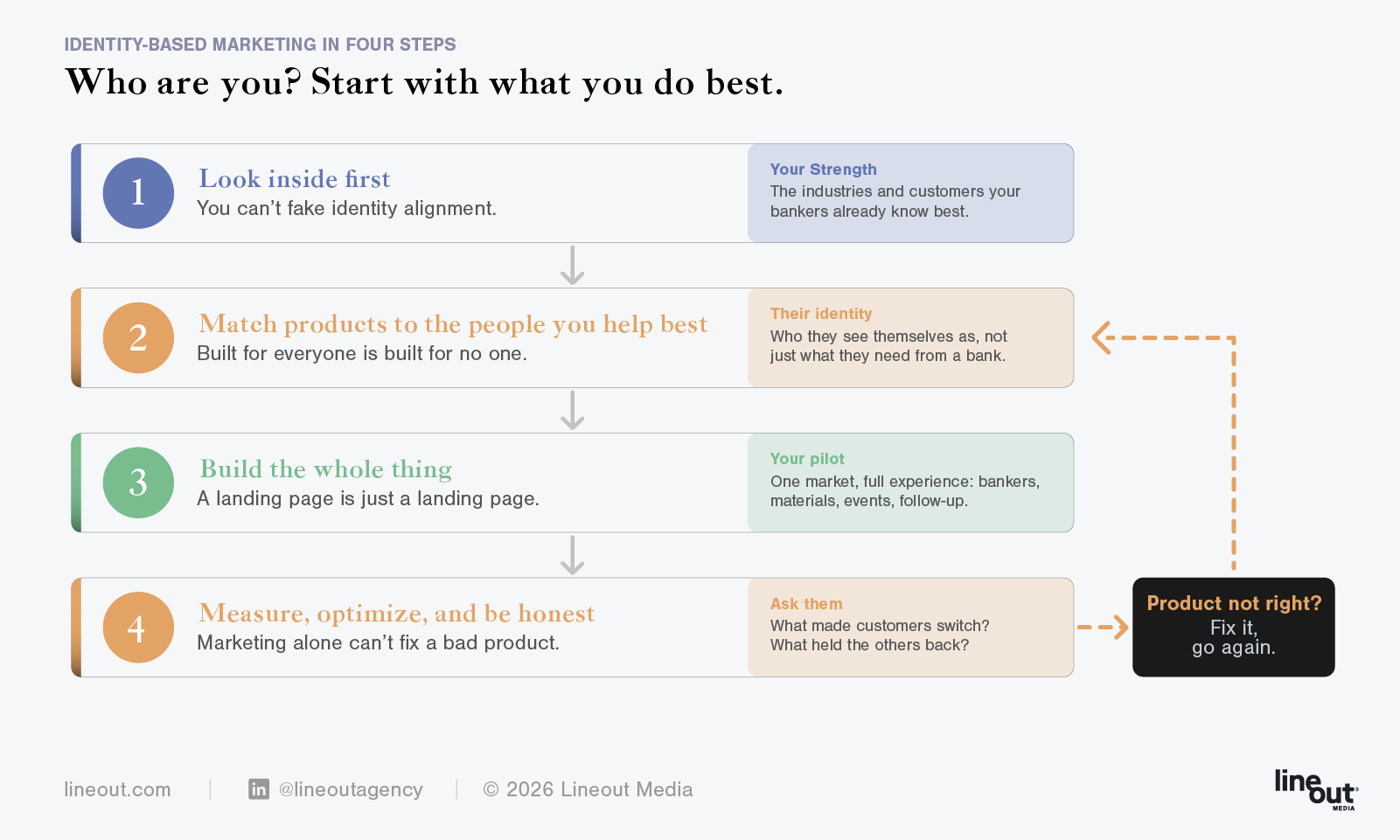
1. Look inside first
What do you do best? Who do you help best? This isn’t something you pull out of a hat. You can’t fake identity alignment, it’s something you already possess.
Let’s say after making the rounds and taking stock, you come to realize your bank is exceptional with franchise owners. Your lenders understand the contracts and agreements. Your team knows the ins and outs of multi-location ownership. Great, now you know who you help best. That’s your starting point.
For Courtney O’Regan, SVP & Director of Marketing at Middlesex Savings Bank, it comes down to who the bank already is: “As a mutual bank, our mission has always been to support the community.” Middlesex is a mutually owned bank, so community is built into the structure. And she says it shows up in what the bank supports: financial literacy, local nonprofits, education.
2. Match products to the people you help best
Knowing who you help best is, of course, only half of the equation. Now you have to look at what you’re actually offering them. And if it’s a product you’ve built for “everyone,” it’s time to rethink that. Because in trying to serve everyone, you’ve actually built a product for no one.
Going back to the franchise owners, if these are your people, what do they specifically need from a bank? Is it financing for a new location? Equipment loans? A lender who has read a franchise agreement before and doesn’t need it explained? Access to bank decision makers? Take stock of which products were actually built for them and which ones treat franchise owners as an afterthought.
Because underneath every need is an identity . A franchise owner isn’t just someone who needs a loan. They’re independent risk-takers, but they like the certainty of an established business model. That’s why they chose a franchise. When your product, and the way you talk about it, speaks to who they are and not just what they need, it taps into those identity-driven choices that happen on autopilot.
Your customers need to see themselves in your bank, which means your products need to be built with them in mind. That’s what they should walk away feeling: this was made for me.
3. Build the whole thing
This is where marketing comes in, whether that’s an agency or your in-house team. Start with ideal customer profiles. Who is your franchise owner? What’s their why? What made them choose a franchise over starting from scratch? Where do they get their information? What podcasts are they listening to? Who do they trust?
Then build around what you learn, and build all of it. This is where a lot of banks stop short. They launch a landing page, call it a franchise program, and then…crickets. Without the rest of the marketing behind it, a landing page is just a landing page. Identity runs on autopilot, and it takes its cues from everything around it. One page can’t carry that alone. The bankers, the materials, the events, the follow-up all have to tell the same story.
So experiment, but experiment with the whole solution. Run a pilot. Pick one market, build out the full experience, and measure the result.
4. Measure, optimize, and be honest
Once it’s live, bring on the scientific method and observe. What’s working? What isn’t? Do more of what’s having an impact and rework what isn’t.
And here’s the hard part: marketing alone can’t fix a bad product. If franchise owners are finding you and still not moving their business over, the problem might not be the message. Switching banks comes with friction. Owners will push through it when the product is right for them. When it isn’t, no campaign can make them take that leap.
So if you didn’t build the right product the first time, go back to the drawing board. Talk to your customers. Ask the franchise owners who signed on what made them switch, and ask the ones who talked to your bankers but didn’t move what held them back. Then fix the product and go again.
So, who are you?
We started with a question that sounds a lot like it belongs on a therapist’s couch. Turns out it belongs in your marketing plan too.
Being a local bank can be part of who you are, it just can’t be all of it. So before your next campaign, have a little existential sit-down and ask the question about yourself first. What do you do best? Who do you help best? Then build around them, all of it, until the people you serve best look at your bank and automatically think: this is for people like me.